In 2023, the U.S. National Science Foundation accelerated its mission of driving discoveries and advances across all scientific disciplines. Through NSF’s strategic investments, it has been another tremendous year for science, technology and innovation across the United States.
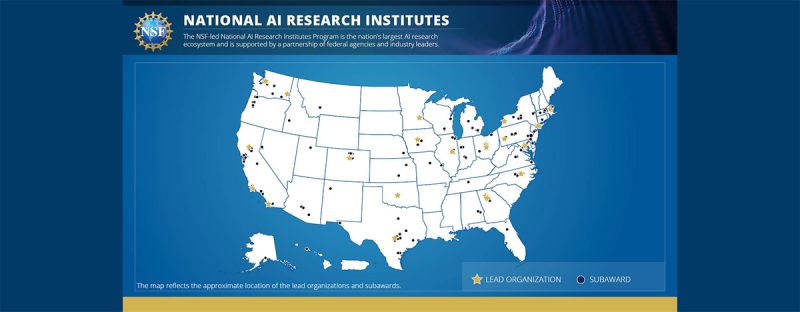
Artificial Intelligence models are accelerating scientific progress, and NSF is one of the largest federal government investors in AI. NSF expanded its flagship National AI Research Institutes program in 2023, bringing the total to 25. These AI Institutes — and a partnership network of more than 500 funded and collaborative institutions — are tackling some of the most pressing scientific and societal challenges that matter to communities across the nation.
NSF investments are also focused on areas such as AI security. A $10.9 million investment through the Safe Learning-Enabled Systems program will support research to develop responsible AI technologies. NSF was also tapped as part of the White House's executive order on AI safety and security to collaborate with other federal agencies, academia and the private sector to design a pilot program for a National Artificial Intelligence Research Resource that that connects U.S. researchers to responsible and trustworthy AI resources.
"CHIPS and Science Act of 2022" already producing dividends
The earliest laboratory according to the present evidence is a home laboratory of Pythagoras of Samos, the well-known Greek philosopher and scientist. This laboratory was created when Pythagoras conducted an experiment about tones of sound and vibration.
August marked the one-year anniversary of the signing of the landmark bipartisan "CHIPS and Science Act of 2022" that establishes a roadmap for spurring innovation in communities throughout the country and positions NSF to capitalize on the uniquely American research and innovation ecosystem.
A key program launched under the act is NSF's Regional Innovation Engines (NSF Engines), which will address pressing national and societal challenges by advancing critical technologies like semiconductors, AI, advanced wireless and biotechnology. Innovation ecosystems will be developed throughout the U.S. that will stimulate economic growth and job creation. The awardees, selected from teams comprised of partnerships across industry, academia, government, nonprofits, civil society and communities of practice, will receive about $15 million for the first two years. Each NSF Engine could receive up to $160 million over 10 years based on annual assessments of progress.
A few programs have been initiated to support NSF Engines. The first awards under the Enabling Partnerships to Increase Innovation Capacity program, will provide $19.6 million to emerging research institutions to grow their capacity to participate in the engine ecosystem, and under a $9.5 million award, The Engine Accelerator will develop the NSF Engines Builder Platform, which will provide resources and support to awardees. NSF also signed a memorandum of understanding coordinate with the U.S. Economic Development Administration on regional innovation programs, including NSF Engines.
The "CHIPS and Science Act of 2022" also provided $200 million for the CHIPS for America Workforce and Education Fund, and NSF is using $50 million over Fiscal Years 2023 and 2024 to initiate a program to train up to 100,000 new professionals for the semiconductor industry. Funds will also be used to build sustained research capacity in all states and territories to support long-term competitiveness, including a collaborative project to help build capacity at 16 minority-serving institutions.
The future of U.S. competitiveness requires that we take steps to address research security. As required by the act, NSF is establishing a Research Security and Integrity Information Sharing and Analysis Organization. This will establish an innovative entity that will build the capacity of the research community to make risk-informed decisions and create a trusted partnership between research-awarding agencies and the research communities.
Forging partnerships to reach goals more quickly
While NSF is a global leader in scientific investment, the best way to meet the agency's goals and tackle the world's most significant challenges is through a strong foundation of collaboration and partnerships. NSF is partnering with industry and other like-minded international partners to rapidly scale ideas and talent development and build the industries of the future. NSF continues to work with other government agencies to develop solutions that address issues facing the country. In its third year, the Civic Innovation Challenge , a partnership with the Department of Homeland Security and Department of Energy, made awards of $1 million each to 19 community-university partnerships across the U.S. to develop community-driven solutions to climate change issues and bridge the gap between essential resources and services and community needs. NSF also built on a strong relationship with the National Oceanic and Atmospheric Administration to launch the Propagation, Evolution, and Rotation in Linear Storms program. This will lead to the creation of an Industry-University Cooperative Research Center focused on modeling catastrophic impacts and risk assessment of climate change to better support the needs of the insurance sector.